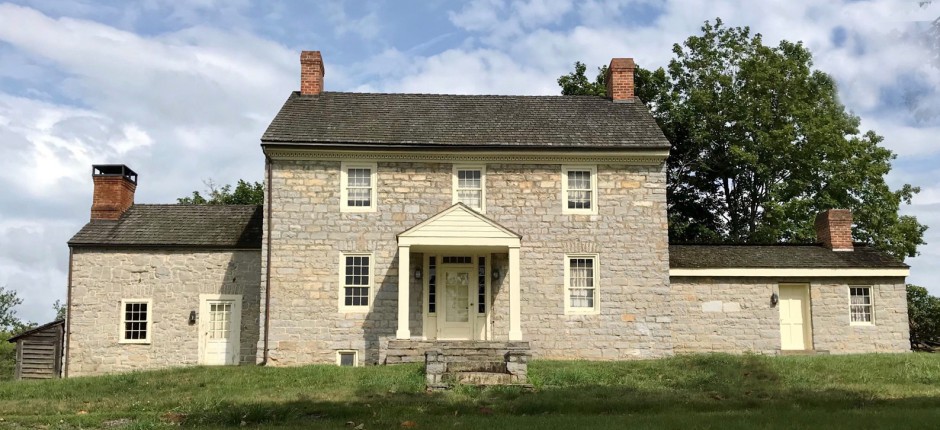
George Chrisman House, circa 1787: A Virginia & National Historic Landmark

GEORGE CHRISMAN HOUSE, in the Shenandoah Valley of Virginia, is located northwest of Route 42 and Edom on Shaver Mill Road (Route 780). 

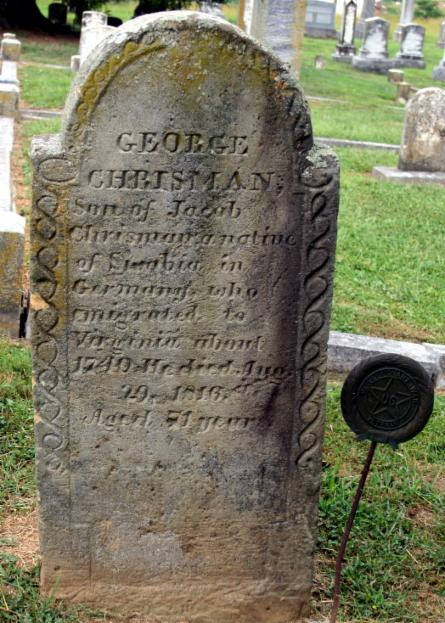
Sometime between 1761 and 1787, George Chrisman (b. 1745, d. 1816) built this limestone house where he lived with his wife Hannah McDowell Chrisman (b. 1744, d. 1817) and their seven children.   In 1781, during the Revolutionary War, George Chrisman was sworn in as a captain in the Rockingham County militia.

In a 1957 letter to the former owners, Shenandoah Valley historian and author John W. Wayland wrote that the house "is probably one of the oldest in Rockingham County." 

George Chrisman’s parents and his older brother were among the many pioneer families who left Pennsylvania in autumn 1731 and traveled by wagon train to Virginia under the leadership of Jost Hite (b. 1685, d. 1761).  George’s father Jacob Chrisman (b. 1706, d. 1778) was a native of Germany who had married Jost’s daughter Magdalena Hite (b. 1713, d. 1771) a few years earlier in Pennsylvania.  Their first child, Jacob Jr., was born around 1728-1730, so the Chrismans made the difficult journey to Virginia with a small child in tow. 

Jost Hite was personally responsible for encouraging and guiding several groups of primarily German families, including his own sons, daughters and their families, to the land west of the Blue Ridge Mountains.  As he was in his own lifetime, Jost Hite is recognized today as one of the earliest settlers of the Shenandoah Valley of Virginia.

The Shaver family owned this stone house for more than 100 years, and the ruins of Shaver Mill, an early 19th century gristmill, can still be seen on the property.  Although known locally for years as "The Shaver Place," in 2006 when the current owners were successful in placing it on the Virginia Landmarks Register and the National Register of Historic Places, the stone house was officially named in honor of its original builder/owner. 

THE CIRCA DATE

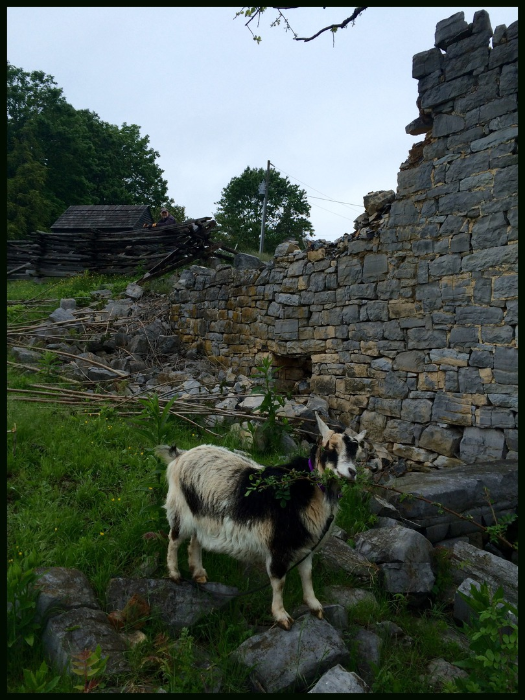
Sometime prior to 1948 most of the north wall of the main house had collapsed and birds, cows and other animals roamed freely inside.  If George Chrisman's house had a date stone high up on the north side, like his father Jacob Chrisman's 1751 stone house (in Frederick County, Virginia), it was most likely lost in the pile of rubble. 

It is impossible to assign a firm date of construction without a date stone or substantiating documentation.  Unfortunately, many early records for Rockingham County have been lost as the result of two fires - one in 1787, and another in 1864 when Union troops intentionally burned courthouse records during the Civil War. 

The earliest existing tax records are from 1787, and although incomplete, the surviving documentation does include a tax record for George Chrisman.  The record shows that the rate of tax paid on the tax value of Captain Chrisman’s property was nearly triple what many other residents in the district paid for comparable land.  This information suggests that there must have already been a substantial structure located on the property.  Other circumstantial elements also lend support to a pre-1787 construction date.    

Born in 1745, George grew up in Frederick County, VA, surrounded by stone houses that had been built by several close family members during the 1750s, including homes built by his father Jacob Chrisman, and his grandfather, Jost Hite.  The Hite men, and men who married into the Hite family like George’s father, must have been extremely well acquainted with all aspects of stone house construction, and George and his other young male relatives may have fetched water or performed other simple tasks to assist with the process.

In 1761 Jacob and Magdalena Chrisman deeded 376 acres on Linville Creek to their sixteen year-old son George.  Five years later in 1766, George was a married twenty-one year-old with a newborn son.  He had to build a house for his growing family.  It must have been determined years before that his home would be made of local Virginia limestone, and George would have started building as soon as he was able. 

By 1779, George and Hannah’s busy German household included four sons, the ages of four, six, ten, and thirteen years old, in addition to a two-year old daughter and an infant daughter.  In 1784 the seventh and last child, a daughter, was born to the Chrismans.  The family was now complete and the American Revolution was finally over.  According to the 1784 Rockingham County Heads of Household Survey, the property of “Capt. George Christman” included “1 dwelling and 3 other buildings.” 

This bronze plaque was a gift from Susan's parents, Paul and Claire Klender shown in the photo above.  Thanks again!

The photo above was taken from the field to the south of the house, looking east at the Blue Ridge Mountains.

Winter 2006. 

NOTE: All early photos used on this website (taken through the 1980s) were graciously presented to the current owners by former owner, M. R. Holm.